
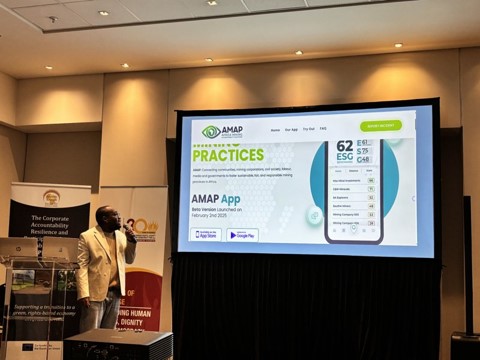
SARW contributed to the session on strengthening coordination and early response mechanisms on the final day of the convening. The presentation opened with a community voice recorded during SARW’s Rights Awareness Workshop in Midrand, which captured the central obstacle facing any protection system: communities that have reported before, and seen nothing follow, will not report again. SARW argued that trust, rather than technology or legal authority, is the binding constraint on early warning, and proposed four building blocks for an effective response architecture. These were trust established through sustained accompaniment and named institutional contacts; the Africa Mining Accountability Platform (AMAP) as a community-owned early warning mechanism with verification preceding escalation; threat-matched response drawing on referral to the SAHRC, the SARW–CALS Anti-SLAPP Toolkit, digital security training and regional solidarity networks; and dialogue as a form of conflict prevention applied across the full project lifecycle.
A key outcome of the convening was the emergence of a validated policy roadmap distinguishing measures that can be advanced immediately by sector actors from those requiring legislative reform. The roadmap includes a shared regional database of attacks on defenders, recognition of community-owned monitoring platforms as legitimate early warning sources, a practical safety toolkit for defenders, anti-SLAPP legislation, dedicated defender legislation pursued at both national and African Commission level, and the extension of consultation and due diligence standards to renewable energy and transmission projects, which currently fall outside mining-specific frameworks. Work also began on a co-created South African Voluntary HREDD Guide, which is expected to serve as the principal institutional vehicle emerging from the dialogue.
The convening confirmed the value of the approach SARW has invested in over several years. Practitioners were direct in their criticism of short-term, extractive engagement with at-risk communities, and equally clear that credible evidence is the foundation of effective protection. AMAP was the only already-operational component of the coordination architecture discussed in the room, placing SARW in a strong position to support the transition from validated recommendations to functioning practice. SARW is now pursuing formal recognition of AMAP as an early warning source within the emerging coordination architecture, and will contribute field evidence from its critical minerals research in the Northern Cape to the drafting of the Voluntary HREDD Guide.
