

When Community Complaints Go Nowhere One participant described how communities may report environmental harm or…
The Southern African Resource Watch (SARW) through its project, Action on Oil and Gas in Southern Africa (AGOSA), seeks to provide a framework to examine the oil and gas extraction within the context of the interplay between natural resource wealth, socio-political dynamics, and transition towards renewable energy, aligning with the Paris Agreement.
The opening remarks were delivered by Davie Malungisa, Senior Advisor at Southern Africa
Resource Watch (SARW) and Glécio Ernestina Massango, Program Advisor at the Institute for Multiparty Democracy (IMD) in Mozambique.
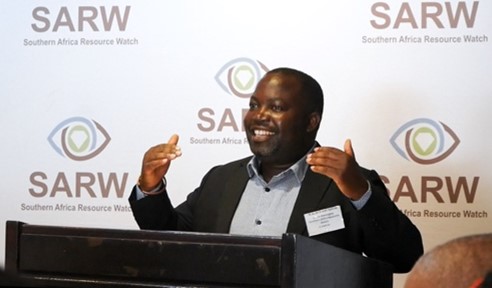
Davie Malungisa, Senior Advisor at Southern African Resource Watch (SARW) officially welcomed the delegates on behalf of Mr. Claude Kabemba, Executive Director of SARW and its Board. In his remarks he highlighted the Action on Oil and Gas in Southern Africa (AGOSA), programme started by SARW in 2024 and outlined the key activities included meetings with political parties in South Africa, DRC and Mozambique where the focus of the meetings was to link party manifestos to electoral cycles on issues of oil and gas and the energy transition. He highlighted the challenge of parliamentary oversight pointing out the direct link between the political parties and parliamentary governance pointing out that members of parliament in Southern Africa must follow the party line stating that “the moment you are out of line you are disciplined”. Malungisa related that SARW have been tracking global climate commitments from the Paris Agreement and COP28 which committed all member states to phase out fossil fuels, starting with coal producing countries. He pointed out that SARW will have a presence at both COP31 which will be hosted by Turkey in 2027 and COP32 which will be an Africa COP hosted by Ethiopia in 2028. Focusing in on the policy dialogue, Malungisa highlighted the importance of the meeting considering the current global shifts and its impacts on the oil and gas industries. In concluding, he reminded the room that transitioning away from oil and gas is inevitable as natural resources is not an infinite commodity.
In concluding, Malungisa, pointed out that the debate around gas as a transition fuel has raised a key concern regarding the dangers of methane emission which is often under reported. According to the International Energy Agency (IEA) “In the oil and gas industry, upstream operations account for nearly 85% of methane emissions, with gas transportation and other downstream operations responsible for the remaining 15%.”
The speakers at the Oil, Gas and Energy Transition Dialogue & Workshop summarized their recommendations for the Oil and Gas landscape in Africa, leaving the workshop with these nine points:
- Natural resources must support long-term development, not short-term revenue.
Resource wealth from oil, gas, and minerals should be managed strategically to build sustainable economic foundations rather than generating temporary income that leaves countries vulnerable once resources decline. - Fiscal resilience requires strong governance and financial management.
Countries need robust systems such as sovereign wealth funds, transparent revenue management, and public accountability mechanisms to protect national budgets from commodity price volatility and economic shocks. - Avoid overdependence on extractive industries.
Heavy reliance on a single sector such as oil, gas, or mining can lead to economic concentration, fiscal instability, and inequality. Diversifying national economies is essential for long-term stability. - Invest resource revenues in productive sectors.
Energy and mineral revenues should be strategically reinvested in sectors such as manufacturing, agriculture, infrastructure, and human capital development to stimulate broader economic growth. - Promote local value creation and beneficiation.
Countries should move beyond exporting raw materials by developing domestic processing industries, strengthening supply chains, and integrating into global value chains. - Strengthen local participation and skills development.
Building national technical capacity, supporting local businesses, and investing in education and training are critical to ensuring that citizens benefit from resource economies. - Expand energy access to support inclusive growth.
Despite large energy resources in the region, many communities still lack reliable electricity. Expanding access particularly in rural areas is essential for supporting small businesses, services, and local development. - A just transition must address structural inequalities.
Economic diversification strategies must consider historical exclusion and ensure that workers and communities dependent on extractive industries are supported through new economic opportunities. - Plan early for post-extraction futures.
Governments should begin preparing now for the eventual decline of extractive industries by building diversified and resilient economies that can sustain livelihoods beyond fossil fuels.