

When Community Complaints Go Nowhere One participant described how communities may report environmental harm or…
In September 2025, Southern Africa Resource Watch (SARW) co-convened and participated in one of the continent’s most significant energy and governance gatherings the 3rd High-Level International Dialogue on Africa and the Energy Transition. The event brought together voices from government, labour, civil society, academia, philanthropy and the private sector to address a defining question: Will Africa lead, follow, or be left behind in the global energy transition?
From its inception in Nairobi, Kenya (2023) and Pretoria, South Africa (2024) to this year’s Dialogue, the platform has evolved into a powerful space influencing global policy agendas from the UN Secretary-General’s Panel on Critical Energy Transition Needs to Africa’s preparations for COP30, the African Climate Summit and the G20.
At the 3rd High-Level International Dialogue on Africa and the Energy Transition, participants made one truth clear; justice must define this transition. Africa cannot continue to export raw materials while importing poverty, pollution and inequality. The continent’s resources must fuel its own industrialisation, energy access and inclusive development.
For Southern Africa Resource Watch (SARW), this was not just a technical debate about minerals and markets. It is a moral and political struggle for sovereignty, accountability and equity in how Africa defines its development future. The Dialogue underscored what SARW has long argued: the energy transition must dismantle extractivism, not rebrand it.
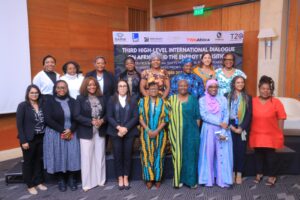
From Extractivism to Transformation
Africa’s minerals should not leave the continent as raw ore but as products that create jobs, build industries and empower communities. The call for beneficiation and value addition was at the heart of the Dialogue’s discussions, echoing SARW’s position that industrialisation is the only path to a just transition. The continent must move from extraction to transformation. Mining revenues must serve people and ecosystems, not disappear into elite capture or corporate profit. Communities living in the shadow of mines must see tangible benefits, decent work, clean environments and a share in the wealth they help generate.
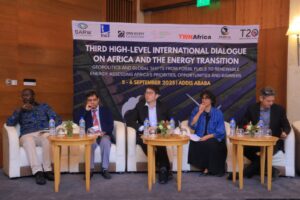
Africa’s Energy Transition: One voice, One Roadmap
The global transition is being defined in boardrooms and summits where Africa’s presence is often fragmented. The Dialogue made it clear that the continent can no longer afford to negotiate from a position of weakness. Africa needs an aligned Just Energy Transition Roadmap, one that unites governments, civil society, labour and communities behind shared priorities. Without a coherent plan, Africa risks being side-lined as powerful blocs set the rules of the green economy. SARW continues to advocate for a coordinated approach that links industrial policy, energy access and climate justice, ensuring Africa enters forums speaking with one voice.
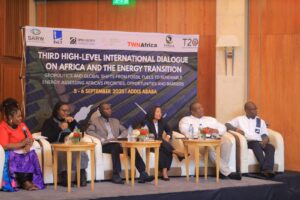
Justice Beyond Rhetoric
The energy transition cannot succeed on injustice. It must be anchored in human rights, environmental integrity and transparency. SARW has repeatedly warned that clean energy built on dirty governance is no transition at all. From mining to energy generation, communities must have a say, civic space must be protected and corruption must be confronted head-on. The Dialogue reinforced that accountability is not optional. Whether through the formalisation of artisanal mining, the protection of indigenous rights, or the inclusion of women in decision-making, Africa’s development must be people-driven and rights-based.

Financing with Integrity
Financing the just energy transition remains one of Africa’s biggest challenges. The Dialogue called for philanthropy and international finance to become catalysts for transformation rather than tools of control. For SARW, this means funding models that amplify civil society, empower communities and support data-driven advocacy. Money alone cannot create justice, only when resources are directed by African priorities can financing deliver lasting impact.
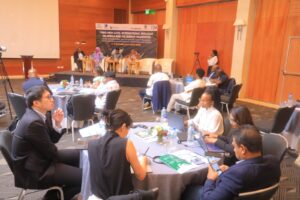
The Path Ahead
The outcomes of the Dialogue will feed into upcoming continental and global policy processes, from the African Union to COP30 and the G20. But the work ahead is not about resolutions; it is about power, agency and ownership. Africa’s minerals must no longer be the source of its poverty but the foundation of its prosperity. SARW remains committed to ensuring that Africa’s transition is not only green but also just. This means transforming mineral wealth into human development, protecting the environment and demanding fairness in every negotiation and every contract.