

When Community Complaints Go Nowhere One participant described how communities may report environmental harm or…
The Third International Dialogue brought together experts across key sectors in Geopolitics, Mining, Finance and Activism. Each panelist brought insights and recommendations to the table which leave much to be considered, and much to carry forward.
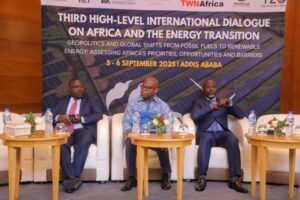
Session 1: Opening
The Dialogue opened with reflections on its growth since Nairobi (2023) and Pretoria (2024), reinforcing its role in shaping global debates on critical minerals and just energy transition. Speakers called for Africa to move beyond being a supplier of raw materials and to lead in industrialisation, sustainability and equitable growth. The ceremony urged Africa to speak with one voice in global negotiations like COP30 and the G20, linking the Dialogue’s outcomes to continental action.
Key Quote:
-
“Our discussions must feed directly into continental and global platforms — strengthening Africa’s collective voice, not rhetoric.”
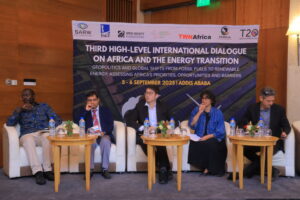
Session 2: Geopolitics and the Global Energy Transition- Will Africa Lead, Follow or Be Left Behind?
This session examined Africa’s place in the geopolitics of energy transition. Speakers stressed that the transition is political, shaped by powerful states and Africa must assert its interests through unity and strategic coordination. Participants called for a rights-based, sovereign African transition narrative that integrates industrialisation, inclusivity and self-determination to avoid marginalisation in global markets.
Noteworthy Quotes and Interventions
- Brian Kagoro (Open Society Foundations): “Africa must decide whether to negotiate from a position of strength or remain at the margins of global power — justice in this transition will not be given, it must be claimed.”
- Dr. Prabhat Upadhyaya (African Climate Foundation): “Africa must sharpen its collective agenda at the G20 and COP30 — the rules of the transition are being written now, and Africa cannot afford silence.”
- Wu Di (Peking University): “China is investing heavily in renewables, but Africa must insist on responsible partnerships that deliver skills, technology transfer, and energy access.”
- Anabella Rosemberg (CAN-International): “The just transition is not just about climate — it is about trade, debt, industrial policy, and the global rules that shape development for the Global South.”
- Patrick Heller (NRGI): “Resource nationalism is resurging globally — but without regional cooperation, Africa risks fragmentation instead of bargaining power.”

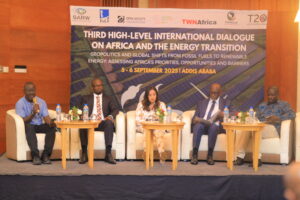
Session 3: Energy Transition and Fossil Fuels in Africa: Oil, Coal and Gas
Speakers explored Africa’s dependence on fossil fuels and the tension between energy security and sustainability. The session emphasised that Africa must design its own transition models that protect sovereignty and deliver energy justice. Stronger governance, accountability and investment in people were urged to ensure that fossil fuel revenues drive equitable development rather than deepening inequality.
Noteworthy Quotes and Interventions
- Hon. Fasiha Hassan (Parliament of South Africa): “Justice is not negotiable — sovereignty and self-determination must guide Africa’s choices in this transition.”
- Bob Felix Ocitti (African Energy Commission): “Africa must define its own transition story, not import one. Our pathway must reflect our resources, our needs, and our people.”
- Charles Nyirahuku (African Development Bank): “Financing Africa’s transition requires coherence — policies must integrate energy, industry, and climate, not treat them in isolation.”
- Joab Okanda (Global Gas and Oil Network): “As the big powers set their course, Africa must build its own alternatives, ensuring energy security and justice for its people.”
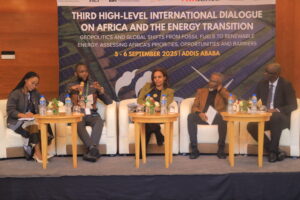
Session 4: Africa’s Critical Energy Transition Minerals Strategies and Policies
Discussions focused on the Africa Mining Vision (AMV) and the African Green Minerals Strategy (AGMS) as key blueprints for transformation. Speakers warned against fragmented policies and weak implementation that could perpetuate extractivism. The session called for policy coherence, continental coordination and stronger accountability to ensure that mineral wealth drives industrialisation and inclusive growth.
Noteworthy Quotes and Interventions
- Mkhululi Ncube (African Union–AMDC): “The Africa Mining Vision and the Green Minerals Strategy provide the blueprint — the challenge is coherence, coordination, and implementation.”
- Dr. Marit Kitaw (UNECA): “We cannot negotiate country by country. Africa must come to the table with one voice, one strategy, and one industrialisation agenda.”
- Tetteh Hormeku-Ajei (Third World Network–Africa): “The debate is not about geology — it is about politics. Without policy coherence and accountability, resources will never translate into transformation.”
- Idriss Mouchili (Coega Development Corporation): “Industrial zones and regional value chains are Africa’s opportunity — but they require investment, infrastructure, and predictable policies to succeed.”
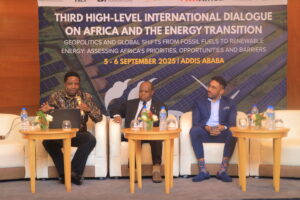
Session 5: Practical Experiences: Critical Minerals Value Chains and Industrial Development
This session drew lessons from Africa’s experiences in developing critical mineral value chains. Speakers warned that without deliberate policies, Africa risks remaining a raw material exporter. Emphasis was placed on governance, infrastructure and policy predictability to attract investment. The session concluded that Africa must prioritise value addition, build resilient regional value chains, and ensure communities and civil society are included in decision-making.
Noteworthy Quotes and Interventions
- Dr. Rob Davies (Former Minister of Trade & Industry, South Africa): “Without value addition, Africa faces a highly unjust transition — we will export raw materials and import finished goods, deepening dependency.”
- Prof. Fr. Rigobert Minani Bihuzo (Loyola University of Congo & Centre d’Études Sociales): “Good governance is not optional — it is the condition for turning mineral wealth into social and economic transformation.”
- Deshan Naidoo (Afrivolt, South Africa): “Africa has the potential to build its own battery industry. What is missing is predictable policy and investment in industrial capacity.”
- Nafal Hassani-Mohamed (Afreximbank): “Capital exists — but it flows where governance is credible and risks are managed. Africa must build trust through strong institutions.”

Session 6: Strategies for Unlocking Just Energy Transition Finance – The Role of Philanthropy
Participants explored philanthropy’s catalytic role in financing the Just Energy Transition. Speakers stressed that while it cannot replace public finance, philanthropy can fund innovation, strengthen civil society and amplify community voices. The session highlighted the need for African-led philanthropy that promotes justice, accountability and evidence-based advocacy while guarding against elite capture and greenwashing.
Noteworthy Quotes and Interventions
- Prof. Fatima Denton (UNU-INRA): “The just transition must secure Africa’s agency, equity, and dignity — philanthropy can take the risks others avoid and amplify frontline voices.”
- Deprose Muchena (Open Society Foundations): “African philanthropy must equalise political participation, giving civil society the evidence and voice it needs as civic space shrinks.”
- Sahele Fekede (African Climate Foundation): “Philanthropy must put communities at the centre of the transition — over 900 million Africans still lack clean energy.”
- Audience intervention: “Philanthropy cannot be neutral. It must choose justice over elite capture if it is to contribute to a real transition.”
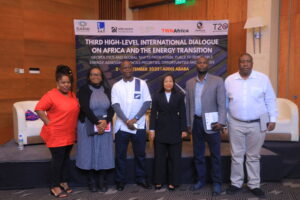
Session 7: Africa’s Critical Minerals and Fossil Fuels – Toward Just, Responsible and Sustainable Extraction
Speakers underscored that extraction must respect human rights, women’s rights and environmental integrity. Artisanal miners, workers and communities shared experiences of exclusion and exploitation. The session called for formalising artisanal mining, protecting civic space and embedding accountability into industrial projects to ensure that extraction supports citizens rather than exploitation.
Noteworthy Quotes and Interventions
- Dr. Liliane Mouan (UN OHCHR): “The energy transition cannot be divorced from human rights. Free, prior and informed consent, and the right to a healthy environment, are non-negotiable.”
- Papy Nsenga (Coordinator of Artisanal Miners, Lualaba DRC): “Artisanal miners are not thieves — we are workers, and the state has an obligation to protect us.”
- Dr. Lesego Molapisi (4T Think Tank): “Workers and unions must not be left out of the just transition. Without them at the table, justice will remain an empty slogan.”
- Farai Maguwu (CNRG Zimbabwe): “Mining cannot be treated as a safe zone where laws do not apply. Accountability must be enforced to protect communities and the environment.”
- Sydney Chisi (Pamoja): “From the Kafue to the Zambezi, extraction crosses borders — so must our solidarity. We cannot leave communities worse off than before.”
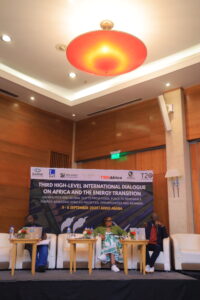

Session 8: Second Africa Climate Summit, COP30 and G20. Does Africa Have an Aligned Roadmap?
The closing session stressed the urgency of a unified African roadmap for climate and energy negotiations. Labour and civil society voices highlighted the absence of a Just Transition framework with clear financing and timelines. Speakers urged African governments to align climate diplomacy with industrialisation and energy access goals to strengthen Africa’s bargaining power at global forums like COP30 and the G20.
Noteworthy Quotes and Interventions
- Zingiswa Losi (President, COSATU): “Africa urgently needs a Just Transition Roadmap — with timelines, financing, and commitments — otherwise we will remain spectators in decisions that shape our future.”
- Dr. Richard Muyungi (Chair, African Group of Negotiators): “Global negotiations move fast, and Africa cannot afford to arrive unprepared. We must engage with one voice, backed by evidence and strategy.”
- Mohamed Adow (Director, Power Shift Africa): “The transition is about power and justice. Africa must align its climate diplomacy with industrialisation and energy access, or risk repeating the mistakes of the fossil fuel era.”
- Kudakwashe (Labour Representative): “Without financing for workers and communities, a just transition will remain a slogan, not a reality.”