
Green Hydrogen: Driving local benefits for a Just Energy Transition
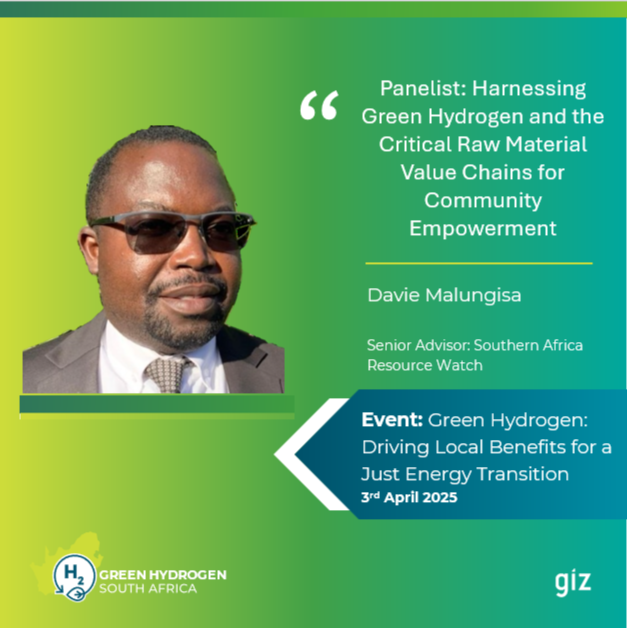
On 3 April 2025, Southern Africa Resource Watch (SARW) participated in a high-level panel discussion hosted by GIZ South Africa under the theme Green Hydrogen: Driving Local Benefits for a Just Energy Transition. The event formed part of GIZ’s H2.SA programme, which supports the development of a green hydrogen economy in South Africa through policy support, research, and stakeholder engagement.
SARW’s Natural Resources and Climate Change Senior Advisor, Davie Malungisa, joined the panel on Green Hydrogen and the Critical Raw Material Value Chains for Community Empowerment. In his remarks, Davie offered a compelling analysis of how green hydrogen (GH2) and critical minerals are deeply interconnected—and why both must be grounded in inclusive, community-centred development models.
Linking Critical Minerals to Community Impact
Davie emphasized that green hydrogen technologies—from electrolyzers to fuel cells—are built on a foundation of critical raw materials such as platinum, vanadium, nickel, and rare earth elements. As demand for GH2 grows globally, so too does the pressure to extract these minerals.
He argued that unless these value chains are structured to benefit local communities, South Africa risks repeating extractive models that leave behind environmental damage and economic exclusion. GH2 must not only support global decarbonization targets—it must also create jobs, business opportunities, and infrastructure investments where minerals are sourced.
Community Benefits: What’s Possible
Davie’s presentation outlined a clear set of community benefits that can be generated from GH2 and critical minerals if managed equitably:
-
Job Creation and Skills Development in mining, processing, and GH2 tech.
-
Business Growth through local manufacturing of electrolyzers, batteries, and fuel cell components.
-
Energy Access via off-grid hydrogen projects in underserved areas.
-
Revenue for Social Development through taxes, royalties, and reinvestment in local services.
-
Environmental Sustainability when hydrogen replaces fossil fuels and mineral extraction is responsibly regulated.
Ownership and Social License to Operate
A key theme in Davie’s remarks was the inseparability of ownership and trust. In South Africa, achieving a social license to operate in mining and energy sectors requires more than compliance—it demands genuine participation, equity, and long-term benefit-sharing.
He cited community trusts, worker equity schemes, and participatory planning as tools that can ensure communities are not just observers, but co-owners of the hydrogen economy. Without this, he warned, projects will continue to face resistance, delays, and reputational damage.
Balancing Exports and Domestic Industrialisation
Davie addressed the growing global demand for platinum group metals (PGMs), noting that while export earnings are important, South Africa must prioritize local beneficiation. Instead of exporting raw PGMs, the country should invest in:
-
Electrolyzer manufacturing (using platinum and iridium),
-
Hydrogen fuel cell industries (for transport and stationary power),
-
Policy frameworks that lock in local content and processing targets.
This approach would support industrialisation, reduce import dependence, and create durable, high-value jobs in a clean energy future.
Preparing for What’s Next
Most GH2 projects in South Africa remain in early stages. Davie stressed that this “waiting period” must not be passive. It should be used to build readiness:
-
Communities should engage in consultation processes, build relevant skills, and negotiate clear benefit agreements.
-
Developers must invest in local partnerships and social trust to avoid future pushback.
-
Local businesses should explore supply chain opportunities and build technical capacity now.
This event underscored SARW’s call for a green hydrogen transition that is socially just, economically inclusive, and environmentally sustainable. As South Africa moves forward with its Just Energy Transition Investment Plan (JET-IP), green hydrogen must be shaped by the needs, voices, and rights of mining-affected communities.